Friday, January 7, 2011

The Organic Deception


By Barbara H. Peterson

Farm Wars

Organic is organic, or is it? It would seem that it is all a matter of perspective when one takes a stroll through the mountains of documents on the FDA and USDA websites.

The word “organic” is fast becoming a high-dollar money-maker for corporations smart enough to jump on the bandwagon and start marketing their products as “made with organic ingredients,” or “certified organic.” Even Monsanto is taking advantage of this burgeoning market, and people naïve enough to believe that what we have traditionally thought of as pure, organic food, is still that way, are being duped.

It makes perfect sense, however, in a Machiavellian sort of way. Flood the food supply with poisons, then lead people to believe that the only safe choice left is USDA Certified Organic. Then buy up the organic companies one by one, and start changing the “organic” rules from the inside out via the bought and paid for government agencies so that you can reap the profits from those trying to escape the poisons.

Click to enlarge

So let’s take a closer look at just what the word “organic” refers to according to these government agencies. You might be surprised at what we find. The fact that the very agencies (FDA and USDA), which are supposed to be protecting our organic food supply, are intensely active in its adulteration will become apparent.

What is “Certified Organic?”

In the USDA Certified Organic Program, there are four categories established for labeling purposes:

Section 205.301 establishes the organic content requirements for different labeling provisions specified under this program. The type of labeling and market information that can be used and its placement on different panels of consumer packages and in market information is based on the percentage of organic ingredients in the product. The percentage must reflect the actual weight or fluid volume (excluding water and salt) of the organic ingredients in the product. Four categories of organic content are established: 100 percent organic; 95 percent or more organic; 70 to 95 percent organic; and less than 70 percent organic. (Organic Labeling Preamble)

If an item is labeled 100% Organic, then it is supposed to contain nothing but organic ingredients and processing aids that are organically produced.

Products labeled Certified Organic must contain 95% organic ingredients.

Up to 5 percent of the ingredients may be nonagricultural substances (consistent with the National List) and, if not commercially available in organic form pursuant to section 205.201, nonorganic agricultural products and ingredients in minor amounts (hereinafter referred to as minor ingredients) (spices, flavors, colorings, oils, vitamins, minerals, accessory nutrients, incidental food additives). The nonorganic ingredients must not be produced using excluded methods [GMO], sewage sludge, or ionizing radiation. (Organic Labeling Preamble)

70-95% Organic, labeled “Made with Organic Ingredients,” can contain the kitchen sink in the 5-30% of ingredients that are not organic. They can be grown with pesticides, but without the sewage sludge, and cannot be irradiated or genetically modified organisms (GMO).

70% Organic, which is labeled “Contains Organic Ingredients,” can contain the kitchen sink along with the pesticides, sewage sludge, irradiation, and GMOs.
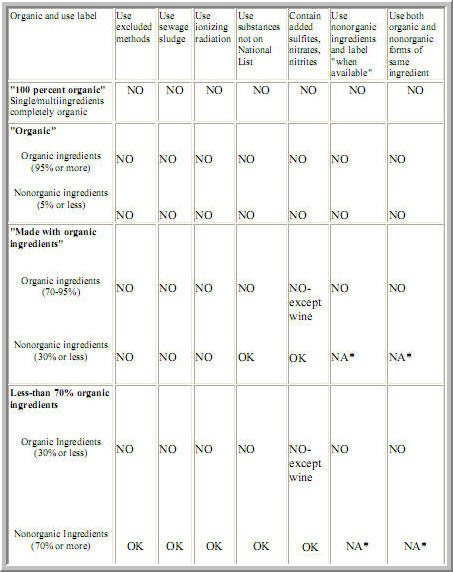
Organic Labeling Preamble Chart

A Matter of Perspective

Let’s say that you have a product that you think is better than its conventional counterpart because it has “certified organic” ingredients. So you buy it and think that you are getting healthier because you are eating mostly good, pure food. It is the word “organic” that led you to believe this. However, if an organic ingredient is mixed with conventional ingredients, doesn’t it become polluted? It’s like putting gasoline in a glass of pure water and charging a premium for that water because it only contains 30% of the contaminant. 30% contamination is probably better than 100%, but would you want to drink it? The whole glass of water is poisoned due to the gasoline, yet the companies selling this product would like you to believe that because it contains pure water it is good. They also know that they can charge you premium prices for that flawed perception.

The FDA and USDA would like us to believe that using “certified organic ingredients” somehow makes the poisons they allow in the other 30% okay, and companies charge through the nose for these adulterated products. It is a matter of perspective. Just how much gasoline in your water are you willing to tolerate just so you can live under the illusion that you are consuming a more pure product? And just how high a price are you willing to pay for it?

Organic Sleight of Hand

“USDA Certified Organic” is a big business, and the deception is great. With a bit of sleight of hand, by simply moving a word around a bit, you have a complete subterfuge.

(1) Use of “Organic” in Product Names. The NOSB, State organic program (SOP) managers, certifying agents, and a large number of individual commenters strongly recommended that USDA prohibit use of the term, “organic,” to modify an ingredient in a product name if the ingredient, itself, is not produced organically. The examples offered were “organic chocolate ice cream” and “organic cherry sweets” in which the ice cream and candy are at least 95 percent organic but the chocolate and cherry flavoring is not organically produced.

We agree with commenters that such product names can be misleading and would be a violation of section 205.300(a). In the examples, the word, “organic,” precedes the words, “chocolate” and “cherry,” and clearly implies that those ingredients are organically produced. The chocolate and cherry flavorings must be organically produced to be used in this way. If the product is at least 95 percent organically produced but the flavoring is nonorganic, the word sequence must be reversed or the word, “flavored,” must be added to the name; e.g., “chocolate organic ice cream” or “chocolate flavored organic ice cream.” A sentence has been added to section 205.300(a) to specify that the term, “organic,” may not be used in a product name to identify an ingredient that is not organically produced. (Organic Labeling Preamble)

So, you see how “organic chocolate ice cream” means that both the chocolate and the ice cream are organic, but if you reverse two words and make it “chocolate organic ice cream,” the chocolate is not organic. Or if you are really adept at manipulation, you can actually manufacture “organic beer” with conventional hops, label it “USDA Certified Organic,” and charge a premium price for it. See the National List of Allowed and Prohibited Substances, which includes hops as one of the approved non-organic substances allowed in USDA Certified Organic products.

Government Treachery

If the FDA is here to help us instead of make money for its corporate owners, don’t you think this agency would demand that labeling be perfectly clear? If the USDA is here to help us, why would it have allowed the gross pollution and treachery that abounds in the National Organics Program (NOP) to have even gotten a foothold in what was the last bastion of safety left in our food supply?

ORGANIC IS ORGANIC. When it is mixed with non-organic ingredients, it is no longer organic, and no amount of agency double-talk will change that. When you play word games to trick people into purchasing something because they see the word “organic” on the label because you have led them to believe it is safe and better than the rest, all in the name of corporate profits, then organic or not, you are one of the bad guys. Period.

Neotame

Wikipedia

Neotame can be included in USDA Certified “Contains Organic Ingredients” without labeling. As I stated in a previous article “USDA Certified Organic’s Dirty Little Secret: Neotame,” Neotame does not have to be labeled. Period. Why? Because the FDA approved it as a general purpose sweetener, and it is designated as a “flavor, or flavor enhancer.” And since it is not a protein hydrolysate, the following applies:

If the flavor consists of two or more ingredients, the label either may declare each ingredient by its common or usual name or may state “All flavor ingredients contained in this product are approved for use in a regulation of the Food and Drug Administration.” Any flavor ingredient not contained in one of these regulations, and any nonflavor ingredient, shall be separately listed on the label. (FDA)

A document taken from the FDA site even states that pre-approval studies indicated that Neotame is not safe, yet it “was approved by the Food and Drug Administration (FDA) for general use in July 2002” (Wikipedia).

Sweetos

Enter Sweetos. Sweetos is Neotame. It was created for human and animal use.

EnSigns Health Care Pvt Ltd and The NutraSweet Co USA have recently launched ‘Sweetos’, a cattle feed sweetener. Sweetos has been developed with neotame, a high intensity sweetener.

Amino acids based sweetener Neotame is 8,000 to 13,000 times sweeter than sugar and is a patented product of the NutraSweet Co USA. Ensigns is one of the leading manufacturers of Sweetos, low calorie sweeteners for the food industry. Together the two companies have launched this sweetener to be added to cattle feed. (Business Standard)

Organic livestock feed uses a similar type of labeling system as human food.

(c) Products sold, labeled, or represented as “made with organic (specified ingredients or food group(s)).” Multiingredient agricultural product sold, labeled, or represented as “made with organic (specified ingredients or food group(s))” must contain (by weight or fluid volume, excluding water and salt) at least 70 percent organically produced ingredients which are produced and handled pursuant to requirements in subpart C of this part. No ingredients may be produced using prohibited practices specified in paragraphs (f)(1), (2), and (3) of §205.301. Nonorganic ingredients may be produced without regard to paragraphs (f)(4), (5), (6), and (7) of §205.301. If labeled as containing organically produced ingredients or food groups, such product must be labeled pursuant to §205.304.

(d) Products with less than 70 percent organically produced ingredients. The organic ingredients in multiingredient agricultural product containing less than 70 percent organically produced ingredients (by weight or fluid volume, excluding water and salt) must be produced and handled pursuant to requirements in subpart C of this part. The nonorganic ingredients may be produced and handled without regard to the requirements of this part. Multiingredient agricultural product containing less than 70 percent organically produced ingredients may represent the organic nature of the product only as provided in §205.305. (GPO Access)

As in human food regulations, the non-organic ingredients in “Made with Organic Ingredients” and “Contains Organic Ingredients” can contain the kitchen sink.

The question must be asked: Do we really want our cattle to be consuming feed that is made with a neurotoxin? How will it affect the animals that eat it? And just how will eating these animals affect us?

Endless Compromise

When did we learn to accept anything less than the best? When did we acquiesce to inferiority? To the endless compromise of our food supply? Why do we think that we somehow deserve to be robbed blind, lied to, poisoned for profit, and cheated every step of the way by the corrupt corporate system that acts like a black hole – sucking in everything and giving nothing back in return except abject misery? And why do we seem to like it? Why do we keep going back for more instead of ridding ourselves of these pariahs? Do you really want to know why? Because we have been trained that way! That’s why we accept “organic beer” made with conventional hops, and USDA Certified “made with organic ingredients” food items that have been poisoned with the likes of Neotame. We accept these things because we have been conditioned to think that this is somehow okay. It’s time to change our way of thinking.

It’s time to stop bowing to multi-national corporations who may or may not be what we think they are. Know your food producer. Know what you are eating. Become a food warrior, and fight for the right to not be deceived. Know how to read labels and figure out what the ingredients really are. The more people that wake up to the reality that we are surrounded by people who could care less about our health and are actually out to do us harm as long as they can profit by it, the better our chances of survival. Make no mistake about it. We are in a food war, and that is a war for our very lives.

© 2010 Barbara H. Peterson

Thursday, January 6, 2011

Frankenswine, the less pungent pig: Scientists genetically modify farm animal so it won't SMELL

By David Derbyshire

Before I post this..probiotics...not gmo..left the pig pic out..reminded me of someone I lived with for way to long...yes she will always be "Sophie to Me" Bette Midler.

Smelly: An ordinary porker. But GM pigs are designed to better digest plant phosphorous - the chief cause of stink.

It looks, sounds and, according to its creators, tastes like a normal pig.

But this is no ordinary farmyard animal. The specially-bred Yorkshire pig is the first of a new generation of ‘Frankenswine’ – genetically modified hogs designed to be cheaper and greener.

The creators of the GM superpig, nicknamed the Enviropig, say its manure contains less phosphorus than normal slurry and poses less risk to rivers, streams and lakes.

But critics of GM food said the animals are ‘anything but environmentally friendly’ – and could lead to more intensive pig farms.

Researchers have been working on the Enviropig for more than a decade.

They believe it will be the first GM animal to be allowed into the food chain and could one day provide sausages, bacon and pork for the world.

Like all creatures, pigs need phosphorus in their diet to help form strong bones, teeth and cell walls.

They are fed primarily on cereals which contains a type of phosphorus that they cannot digest. Most farmers have to feed pigs an enzyme called phytase to make plant phosphorus digestible.

But phytase supplements are not very good at breaking down phosphorus, so a large amount is flushed out of their bodies in waste.

The phosphorous-rich manure can make its way into the water supply where it triggers algal blooms, which choke aquatic life and create ‘dead zones’ for fish.
Algae: Regular pig manure can pollute streams and ponds, like above

Algae: Regular pig manure can pollute streams and ponds, like above

Unlike normal pigs, Enviropigs have been designed to produce their own phytase.

Researchers took a gene responsible for the creation of phytase from an E.coli bacteria and added it to the genetical make-up of a Yorkshire pig.

To make sure the bacterium gene would work in the animal, they combined it with a gene taken from a mouse before inserting it into the Enviropig’s DNA.

In tests, the Enviropig was able to absorb more phosphorous from its feed. Its waste contained less of the potentially toxic substance.

Its meat also appears to be identical to cuts from a traditional Yorkshire pig.

One of the pig’s creators, Professor Rich Moccia, of the University of Guelph, in Ontario, Canada, told the BBC: ‘They are pretty friendly and pretty gregarious.

'These pigs are almost identical to a normal Yorkshire pig. They look normal, they grow normally and they behave normally.’

Earlier this year the Canadian government approved the animal for production and breeding in laboratories. But it is still not allowed in the food chain – and is years away from being approved.

Vicky Hird, of Friends of the Earth, said the name Enviropig ‘was a huge irony’.

She added: ‘Pigs reared in these intensive units can never be sustainable because they require so much soya which is grown by clearing forests which leads to more greenhouse gases being released.

‘And when it comes to GM food, consumers are voting with their feet. They won’t accept it.’

Read more: http://www.dailymail.co.uk/sciencetech/article-1344172/Frankenswine-Pigs-genetically-modified-smell.html#ixzz1AJffZBON

I have been sitting on this a while. Here it is.


Dec
31
USDA Certified Organic’s Dirty Little Secret: Neotame

By Barbara H. Peterson

Farm Wars

Just when we thought that buying “Organic” was safe, we run headlong into the deliberate poisoning of our organic food supply by the FDA in collusion with none other than the folks who brought us Aspartame. NutraSweet, a former Monsanto asset, has developed a new and improved version of this neurotoxin called Neotame.

Neotame has similar structure to aspartame — except that, from it’s structure, appears to be even more toxic than aspartame. This potential increase in toxicity will make up for the fact that less will be used in diet drinks. Like aspartame, some of the concerns include gradual neurotoxic and immunotoxic damage from the combination of the formaldehyde metabolite (which is toxic at extremely low doses) and the excitotoxic amino acid. (Holisticmed.com)

But surely, this product would be labeled! NOT SO!!! For this little gem, no labeling required. And it is even included in USDA Certified Organic food.

The food labeling requirements required for aspartame have now been dropped for Neotame, and no one is clear why this was allowed to happen. Neotame has been ruled acceptable, and without being included on the list of ingredients, for:

* USDA Certified Organic food items.
* Certified Kosher products with the official letter k inside the circle on labels. (Janet Hull)

Let me make this perfectly clear. Neotame does not have to be included in ANY list of ingredients! So, if you buy processed food, whether USDA Certified Organic or not, that food most likely will contain Neotame because it is cost-effective, and since no one knows it is there, there is no public backlash similar to what is happening with Aspartame. A win/win situation!

But that’s not all. Just love chowing down on that delicious steak? Well, that cow most likely will have been fed with feed containing…..you guessed it…..Neotame! A product called “Sweetos,” which is actually composed of Neotame, is being substituted for molasses in animal feed.

“Sweetos is an economical substitute for molasses. Sweetos guarantees the masking of unpleasant tastes and odor and improves the palatability of feed. This product will be economical for farmers and manufacturers of cattle feed. It can also be used in mineral mixture,” said Craig Petray, CEO, The NutraSweet Company, a division of Searle, which is a part of Monsanto. (Bungalow Bill)

Why would we feed animals food that is so distasteful that we would have to mask the unpleasantness with an artificial sweetener? Most animals will not eat spoiled, rancid feed. They know by the smell that it is not good. Enter Sweetos (Neotame). Just cover up the unpleasant tastes and odors, and you can feed them anything you want to, courtesy of the oh, so considerate folks at Monsanto and company.

But of course, Monsanto is no longer associated with NutraSweet. In the time-honored tradition of covering its assets, Monsanto has a proven track record of spinning off controversial portions of its company that generate too much scrutiny, such as it did with the Solutia solution.

Says the Farm Industry News, “Monsanto, which has long resided in the crosshairs of public scorn and scrutiny, appears to have dodged at least one bullet by spinning off its industrial chemical business into a separate entity called Solutia a couple of years ago. Solutia has since been hammered by lawsuits regarding PCB contamination from what were once called Monsanto chemical plants in Alabama and other states” (Source Watch)

So what is the solution to this problem? Buy local organic food, know your local farmer, and don’t buy processed foods whether they are labeled “Organic” or not. This requires a drastic change in lifestyle that most will not want to make. For those who choose to ride the wheel of chance by succumbing to this genocidal adulteration of our food supply by those who stand to profit from our sickness and early demise, my only comment is….it is your choice. But for those of us who have decided to fight this battle one bite at a time by hitting these sociopaths in the pocketbook where it hurts……viva la revolucion!

Saturday, January 1, 2011

The Law Of Abundance


The Laws of Abundance are part of the Laws of Manifestation, and are very similar to those laws with only a small variation. The difference is primarily that you align yourself with the flow of abundance by giving away what you want to receive.

The five steps of the Laws of Abundance are listed below and are easy to understand and remember. Although these are simple steps, they still often present a challenge to practice and live. When using the Laws of Abundance, it is important to remember to give freely, without expectation of return, because there is already plenty of what you desire. There is more than enough for everyone and the flow of Abundance makes it easy to receive. It does not matter who you are, what you have done, or how important or unimportant you might believe you are. None of that makes any difference. The way it works is the same for everyone. All that is needed to step into the flow of abundance is to follow the simple five steps outlined below.

1. Give what you want to receive. The flow of Abundance is already all around you. To step into this flow is easy. Give to someone else the very thing you would like to receive. And give it freely without expectations of receiving, as if you already had more than enough. If you want more kindness in your life, be kind to someone, if you want more happiness in your life, make someone else happy, if you want more money in your life, share a little of what you have. Give it away easily, like you already had all that you need and there is plenty more from where that came from.

2. Trust and know. The next step is to trust and know you have just stepped into the flow of abundance and are now aligned with what you want. Know there is more than enough to go around and it is easy to have all you want.

3. Take Action. Participation is an important part of Abundance. While you are knowing you are now aligned with the flow of the abundance you want, it is also important to participate and help make things happen. Follow your inner knowing and your intuition and do your part to help create the abundance you would like to have. Continue to participate until you are receiving what you want.

4. Be Grateful. Gratitude is a vital step in the flow of abundance. It is a powerful magnet which keeps us in the flow and aligned with receiving all the wonderful things we desire. Fill yourself with gratitude all the time, even about the small and seemingly simple things in your life. There is always something to be grateful about. When you notice a little of what you want flowing to you, take a moment and be grateful for what you have received, regardless of how big or small it may be. Be grateful and say thank you.

5. Pass it on. When you receive a little abundance take a moment and pass some of it on and assist someone else in feeling a little more abundant. When you pass on some of what you receive, do it easily as if you already have more than you need, expecting nothing in return. When you pass it on in this way you are now starting the process all over again and have once again taken the first step to "give what you want to receive." In this way the flow of abundance continues and becomes more and more each time.

Thursday, November 25, 2010


Vegetarian Chili

Here's a tasty chili recipe that will bring about some tummy warming on a cold winters day.


Ingredients

* 1 tablespoon extra virgin olive oil
* 1 large onion (chopped)
* 2 bay leaves
* 1 teaspoon ground cumin
* 2 tablespoons dried oregano
* 1 tablespoon Celtic or Himalayan salt (or to taste)
* 2 stalks celery (diced)
* 2 red peppers (diced)
* 2 jalapeno peppers (seeded and diced fine)
* 3 garlic cloves (peeled and minced)
* 3 (28 ounce cans whole tomatoes (chopped fine)
* 1 tablespoon chili powder (to taste)
* 1/8 teaspoon cayenne pepper (to taste)
* 1 (15 ounce can kidney beans (drained)
* 1 (15 ounce) can garbanzo beans (drained)
* 1 (15 ounce) can black beans (drained)
* 1 (15 ounce) can whole kernel corn (drained)

Directions

1. Heat olive oil in a large pot over medium heat.
2. Stir in the onions, seasonings with bay leaves, and salt. Stir until onion is clear in color.
3. Then stir in celery, bell peppers, jalapeno peppers and garlic.
4. Cover, reduce heat to low and simmer 5 minutes.
5. Add tomatoes. Then add beans and bring to a boil.
6. Reduce heat to low and simmer for 45 minutes.
7. Stir in corn, and it is ready to serve following a huge salad, along with some hearty, whole grain bread.

Try this tomorrow and forget about Black Friday...The bargains are yet to be had.

And forget ginger.....

Wednesday, October 20, 2010


Starvation 2011

Do you believe that you will always be able to buy inexpensive food at the supermarket? If so, you might want to think again. During 2010, agricultural commodity prices have exploded. Nearly every single important agricultural commodity is experiencing double-digit percentage price increases. The S&P GSCI Agriculture Index recently surged to a fresh two-year high and now we find that food producers and retailers are starting to pass those commodity price increases on to consumers.

Food inflation is real; it is here and it’s going to hurt a lot of people. In fact, food inflation is hitting consumers hard all over the globe this fall. According to the United Nations, international wheat prices have soared 60 to 80 percent since July. Since the beginning of 2010, the price of bread has gone up 17 percent and the price of meat has gone up 15 percent in European Union countries. The inflation rate in Russia rose to 7 percent in September primarily because of rising food costs.

The New York Times reported, “First it was heat and drought in Russia. Then it was heat and too much rain in parts of the American Corn Belt. Extreme weather this year has sent grain prices soaring, jolting commodities markets, and setting off fears of tight supplies that could eventually hit consumers’ wallets. Grain prices started to shoot up over the summer on reports of a catastrophic drought in the major wheat-producing regions of Russia, Ukraine, and Kazakhstan. Prices rose not only for wheat, but also for corn and soybeans, since those grains are interchangeable as animal feed and a drop in wheat production could mean increased demand for the other grains.”

Corn prices surged again last week after a new report from the United States Agriculture Department said this year’s corn crop would be smaller than expected. The harvest is forecast to be 3 percent lower than the 2009 crop. In Canada Prairie farmers have faced near impossible planting conditions this year. In Saskatoon, for example, 290 mm of rain fell throughout the summer. The average rainfall amount is 184 mm. Both Regina and Winnipeg also saw above average rainfall amounts, which left fields too saturated to get into. If the wet and soggy conditions weren’t already bad enough, an early frost gave farmers yet another barrier to contend with. The cooler temperatures not only lead to a loss in crop yield, it also limits the time spent in the field for production.

Fresno County in California ranks first in the U.S. in agricultural sales every year. “Drive around it today, however, and you’ll think you are in a desert. The tap has been turned off and area farmers are not receiving their promised allotments. The locals call it a “Congress-created Dust Bowl.” The San Joaquin Valley suffers a 15 percent rate of unemployment while unemployment in water-deprived communities soars to 36 percent. The unemployment rate in Fresno County notches 40 percent. Farmers, local governments, small businesses and unemployed workers all cite the shortage of water as the predominant factor. According to a May 2009 study conducted by the University of California-Davis, more than 35,000 jobs and billions in economic revenue have been lost as a result of the manmade drought. Since then, those numbers have continued to climb.”

In Korea, over the past 12 months, the price of cabbage—the main ingredient in kimchi, the country’s national dish—has risen over 400% to 11,500 won ($10) from 4,000 won two weeks ago and 2,500 won a month ago. “This is the first time that cabbage prices have gone up so much,” Park Young-koo, researcher at the Korea Rural Economic Institute, told the Wall Street Journal. “Since we have monitored the price, nothing like this has happened before.”

In a recent article entitled “An Inflationary Cocktail In The Making,” Richard Benson listed many of the other agricultural commodities that have spiked in price in 2010… coffee: 45%, barley: 32%, oranges: 35%, beef: 23%, pork: 68%, salmon: 30%, sugar: 24%… and the list goes on and on with the worst yet to come.

The number of people in the United States needing food stamps to survive is trending toward 45 million. There are 60 million on Social Security and they are not getting any cost of living allowance (COLA) increases to compensate for inflation in 2010, nor will they get any in 2011. Those living on fixed incomes or government assistance are being ravaged by exploding inflation. A global food crisis is brewing and with it massive inflation is arriving at a time when we have the most people on government assistance since the Great Depression. The price of food is going to continue to go up and the value of our paper currencies will continue to go down as the race to the bottom continues.

When a large segment of the population is facing a drastic cut in income in the face of escalating food prices, we have a catastrophic problem in the making. Today we have the simultaneous events of income deflation and food inflation, two high-speed express trains coming down the tracks at each other, plus a financial crisis colliding with staggering crop losses that are cutting deeply into available planetary food reserves. Prices of food are beginning to soar again just as millions are losing the ability to afford a reasonable diet, though little of this is being observed or reported. But soon even the blind will see.

Very few people in the U.S. have given any serious consideration to the question of food security. This essay should convince people that it’s time to start. For the most part, we’re not aware of the problem, but if we look hard at the “hidden” news we see that the handwriting is on the wall for an unimaginable crisis that will come on us as early as next year.

http://intotheashes.imva.info/breaking-news/hunger-starvation-to-visit-humanity

Monday, October 4, 2010


What are we Harvesting?

Autumn Equinox brings the peak of harvest season so I take some time to consider what my Heathen spirit has managed to coax into a harvest on our land. I can hear the rooster crowing, again, and I’m reminded of our egg harvest. I think the rooster is calling to our newest and somwhat wild hen, who can fly out of the coop and likes to forage just outside of the fence where he can’t reach. It’s said a rooster crows about every hour or so to let the hens know where he’s at and I’d have to agree he does crow regularly. Last night it was the full moon and that had him crowing at night as well. Home grown eggs are just delicious and worth the music, though a rooster isn’t necessary for egg production.

Eggs were recently in the news when “Wright County Eggs” located in Iowa recalled half a billion eggs sold across 8 states under 13 different labels for possible salmonella contamination. That’s a lot of eggs coming from one area. Apparently most commercial eggs come from large factory farms today. Up until about 20 years ago small egg houses were scattered across every state making them a local product. Unfortunately huge factory farms seem to be the way of the future and the family farms have all but disappeared. Check the label on any purchased egg carton and see how far it has traveled by visiting this web site: http://www.organiclinker.com/egg-miles.cfm.

Know what the label on the carton means, sometimes they are misleading. Any eggs labeled “Certified Humane” or “Certified Organic” must follow particular rules: “Certified Humane” chickens are cage free with density requirements, while “Certified Organic” chickens must have outdoor access and be fed only organic feed. Some sources claim that no nutritional differences exist between commercial and Humane or Organic eggs, however Mother Earth News conducted their own studies in 2007 which seem to show the opposite is true.

“Compared to official U.S. Department of Agriculture (USDA) nutrient data for commercial eggs, eggs from hens raised on pasture may contain:

• 1/3 less cholesterol
• 1/4 less saturated fat
• 2/3 more vitamin A
• 2 times more omega-3 fatty acids
• 3 times more vitamin E
• 7 times more beta carotene”[1]

The slow food revolution can help offer consumers more responsible choices, if they can accept the added expense that quality usually demands. But what’s the harvest we are getting if we don’t make the responsible choice? More factory farms, less humanely raised food, lower nutritional value, soylent green…oops my mind is wandering…You can find locally grown foods on web sites such as http://www.localharvest.org/.

Or try raising your own eggs! Anyone can raise laying hens: even in the city (local zoning permitting) they require only a small area of space. Secure housing is the number one priority, something with a roof if at all possible. Commercially available chain link dog pins can offer a quick choice, or something similar. Additional wire stretched across the top will save your chickens from predators like possums and dogs. Sources and tutorials for chicken and egg culture abound on the internet.

If the sound of a rooster is putting you off from having your own laying hens remember that roosters aren’t actually necessary to produce eggs. Instead a high protein diet promotes the laying of infertile eggs – so you are not even taking a life when you eat one! However a rooster does spice up the coop.

One large egg has about 70 calories, 6 grams of protein mostly from the white, and 5 grams of fat mostly from the yolk. They also contain the antioxidant lutein, in an easily digested form, which is essential for healthy eyes.

The rooster is crowing again. The wild hen seems to be getting used to him and finding his calls more and more attractive. We hope this is the case because she has the mothering instinct, meaning she will sit on her eggs faithfully to get the next generation started.

Hail the Harvest!